Poker Hand Rankings and Combinations
Discover our easy summary chart to visualize the ranking of different poker hand combinations.

Poker hand rankings will no longer hold any secrets for you.
In poker, particularly in Texas Hold'em (the most commonly played variant), the strength of your hand depends on the five-card combination you form.
Understanding hand rankings is essential to knowing when to bet, raise, or fold. This article presents all poker combinations, from the strongest to the weakest, with concrete examples and associated probabilities.
Poker Hand Rankings Summary Chart
As shown in the poker hand rankings chart, the order of poker combinations (from strongest to weakest) is: Royal Flush, Straight Flush, Four of a Kind, Full House, Flush, Straight, Three of a Kind, Two Pair, One Pair, High Card.
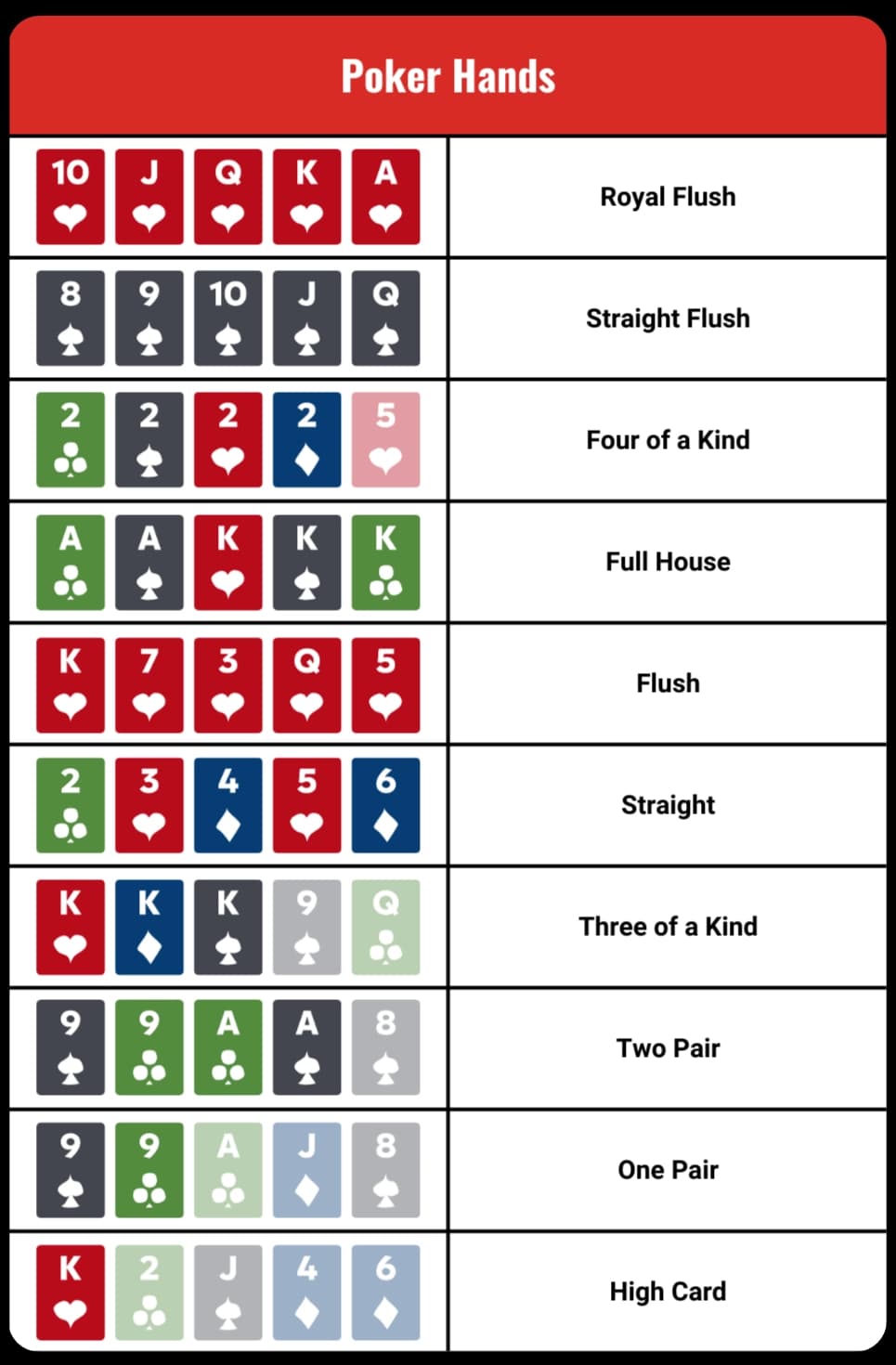
You can also access this chart in PDF format by clicking the following link: chart in PDF format.

Our latest videos
Explanation of Poker Hand Combinations
How are combinations formed?
In poker, particularly in variants like Texas Hold'em (the most commonly played variant), each player receives two face-down cards (called "hole cards") that only they can see.
Then, five community cards (shared by all players) are placed in the center of the table over the course of the betting rounds. The objective is to form the best five-card hand using a combination of your hole cards and the community cards. You can use:
- Your two hole cards and three community cards.
- One of your hole cards and four community cards.
- Or even just the five community cards if that gives you the best possible hand.
Example of forming a combination
Let's take an example to make this clearer. Imagine you have the following hole cards: A♦, 4♥
The community cards on the table are: K♥, Q♦, 10♠, J♦, 8♣
In this case, you form a straight using the Ace from your hand and four community cards (K-Q-J-10). Your hand is an Ace-King-Queen-Jack-10 straight. Your 4 of hearts is useless — the Ace alone completes this combination.
Detailed Breakdown of Each Hand
Here is a detailed explanation of each poker hand, ranked from weakest to strongest.
1. High Card
When you haven't formed any of the following combinations, the highest card determines the strength of your hand.
Example: A♥, 10♣, 7♥, 5♠, 3♥ (highest card = Ace).
If multiple players are in this situation, the highest card wins. If necessary, the next highest cards are compared to break the tie.
2. One Pair
Your combination includes two cards of the same value.
Example: 8♠, 8♦, K♦, 10♦, 3♣ (pair of 8s).
If two players have a pair, the one with the higher pair wins. If the pairs are identical, the tie is broken by comparing the highest remaining card (called the kicker).
3. Two Pair
This hand consists of two pairs of cards of the same value.
Example: K♣, K♦, 10♣, 10♥, 2♦ (two pair, Kings and 10s).
If two players have two pair, the one with the higher pair wins. If they are equal, the second pair is compared, then the kicker if needed.
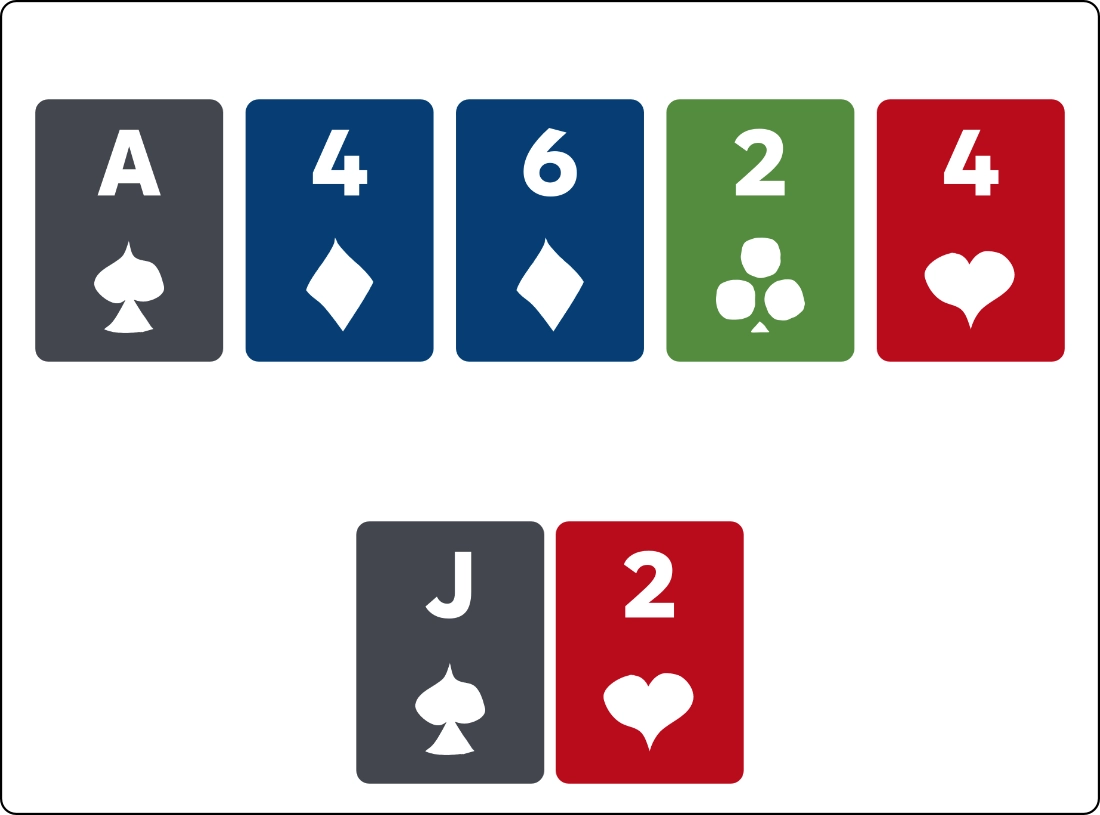
4. Three of a Kind
This combination is formed by three cards of the same value.
Example: Q♥, Q♦, Q♣, 6♥, 2♦ (three Queens).
If multiple players have three of a kind, the one with the highest value wins.
5. Straight
A straight consists of five consecutive cards.
Example: 9♣, 8♦, 7♣, 6♠, 5♣ (straight from 9 to 5).
The Ace can be used either as a high card (above the King) or as a low card (before the 2). If multiple players have a straight, the highest one wins.
6. Flush
A flush consists of five cards of the same suit (spades, hearts, diamonds, or clubs), but not in sequence.
Example: A♠, K♠, 10♠, 5♠, 3♠ (Ace-high spade flush).
If multiple players have a flush, the one with the highest card in their flush wins.
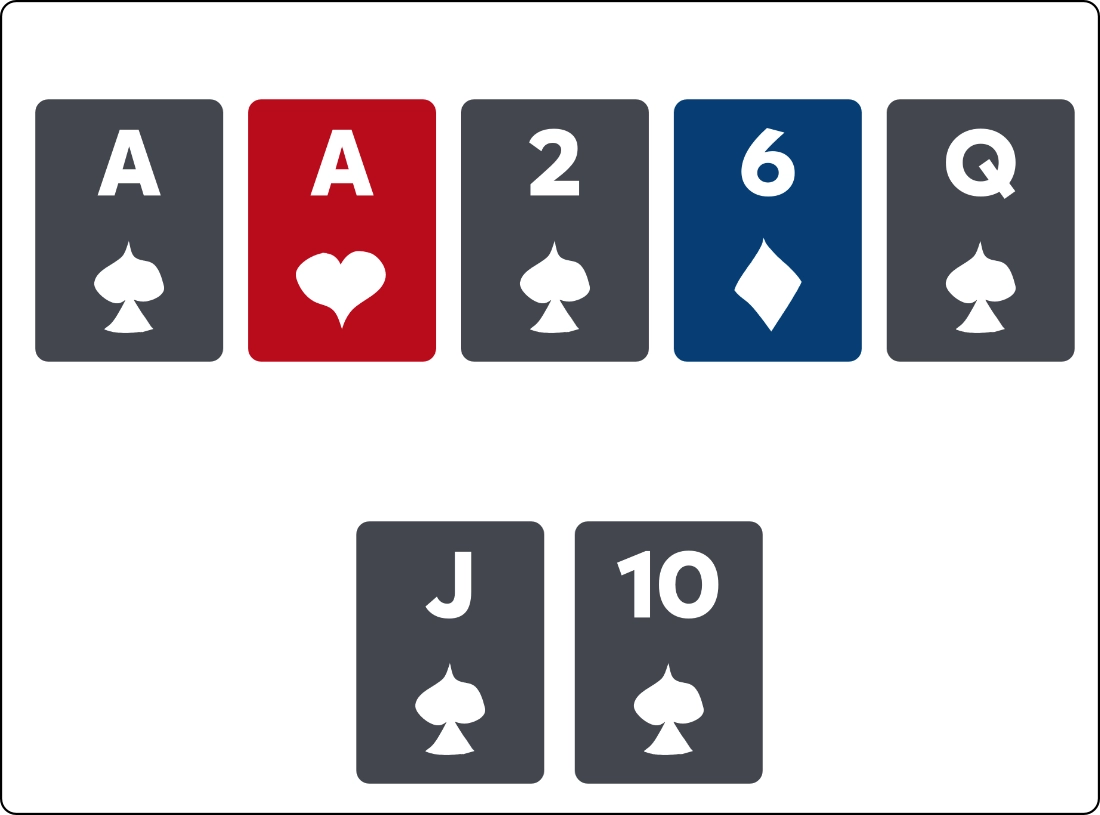
Be careful, 7♠, 8♣, J♠, A♣, 2♠ is NOT a flush! Even though clubs and spades are both "black," in poker they are considered different suits. The same applies to diamonds and hearts.
7. Full House
A full house is a combination of three of a kind and a pair.
Example: J♠, J♦, J♣, 5♣, 5♦ (Jacks full of 5s).
If two players have a full house, the one with the higher three of a kind wins. If both have the same three of a kind, then the one with the stronger pair wins the pot.
8. Four of a Kind
Four of a kind consists of four cards of the same value.
Example: 9♠, 9♥, 9♦, 9♣, 2♠ (four 9s).
If two players have four of a kind, the one with the higher value wins.
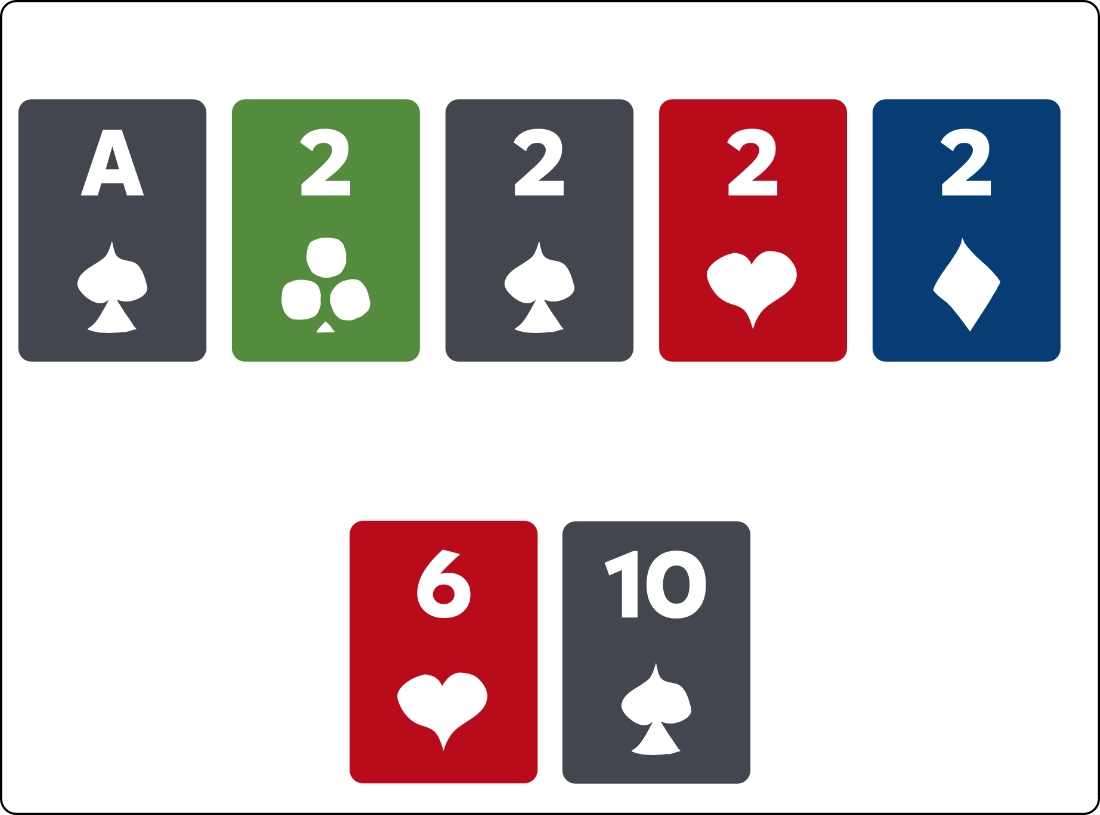
9. Straight Flush
This is five consecutive cards of the same suit.
Example: 10♣, 9♣, 8♣, 7♣, 6♣ (club straight flush).
This is an extremely rare hand. If multiple players have a straight flush, the highest one wins.
10. Royal Flush
The best possible hand in poker. It consists of the Ace, King, Queen, Jack, and 10 of the same suit (note that it is a special case of a straight flush — the best possible straight flush). This hand is unbeatable.
Example: A♥, K♥, Q♥, J♥, 10♥ (royal flush of hearts).

















Probabilities Associated with Each Hand
Each card combination has a very specific probability of appearing, with the rarest being the royal flush and the most common being one pair.
Here are the probabilities of getting each poker combination if you go all the way to the river (so with seven cards in play: your two hole cards and the five community cards):
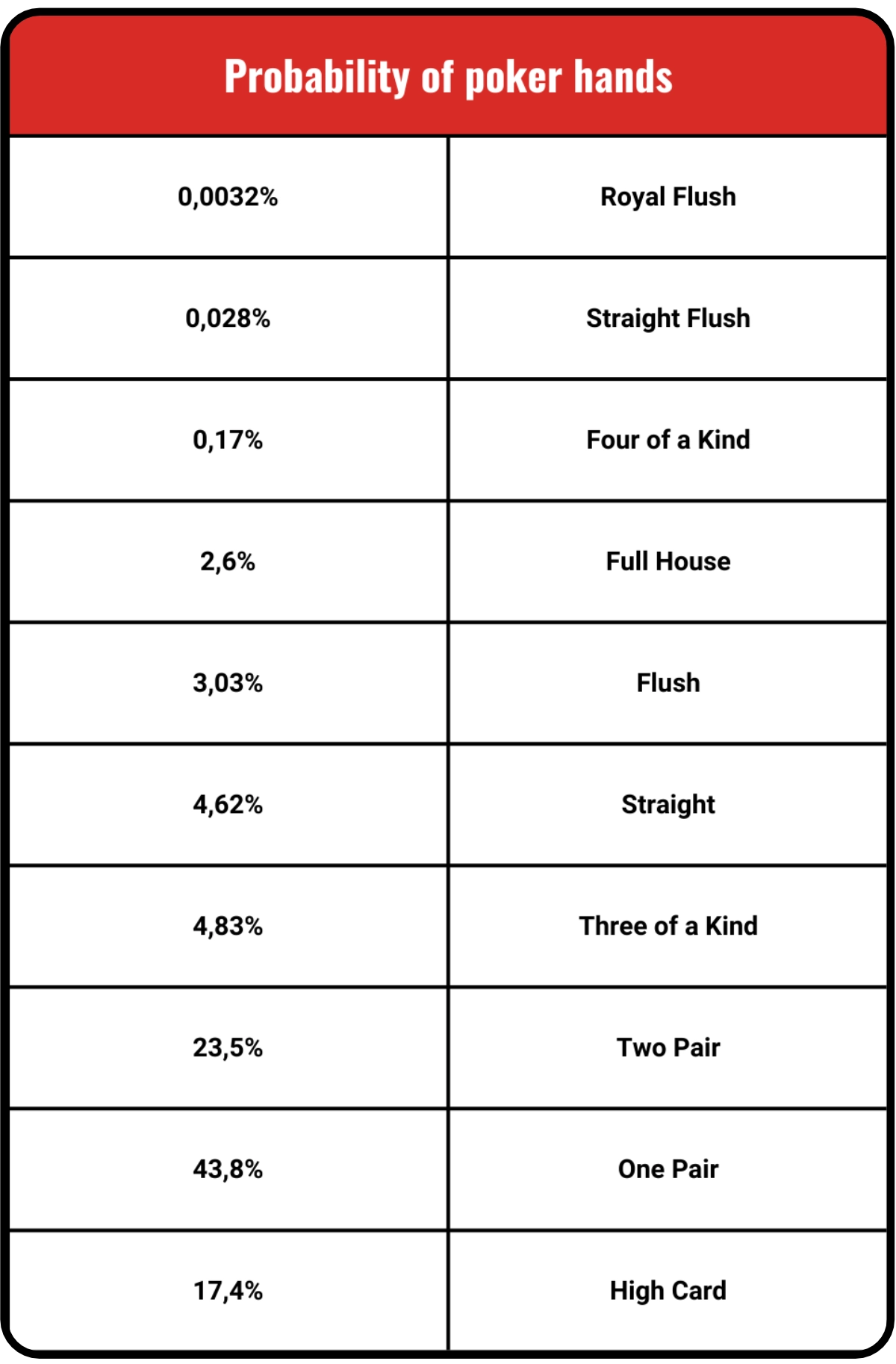
Surprisingly, the probability of "having nothing" (high card) is lower than that of having a pair. Thus, in poker, particularly in Texas Hold'em, it is common to form at least one combination.
However, it is important to note that these probabilities indicate the chances of getting each hand if the game goes all the way to the river, meaning when all 5 board cards (flop, turn, and river) are revealed.
In practice, this scenario doesn't always occur, as it frequently happens that all players fold before these cards are dealt.
Frequently Asked Questions About Hand Rankings
To conclude, here is a summary of the main questions beginner poker players ask about different poker hands.
What is the best hand in poker?
The best hand in poker is the royal flush. It consists of five consecutive cards of the same suit, from 10 to Ace. For example: 10♠, J♠, Q♠, K♠, and A♠.
What is the probability of getting a royal flush?
The probability of receiving a royal flush is extremely low. In Texas Hold'em, it is approximately 0.0032% (going to the river), or a 1 in 31,250 chance. In practice, most poker players will only see a few in their lifetime, and some will unfortunately never see one.
What happens if I have the same hand as my opponent?
If you and your opponent have the same hand, it is a split pot. This means the pot is divided equally between you.
However, this case is rare because your combinations must be absolutely identical, since in most situations a difference in card rank is enough to break the tie.
For example:
If you have the following three of a kind: 4♣, 4♥, 4♦, K♥, Q♣ and your opponent has: 4♣, 4♥, 4♠, 2♣, Q♣ then you beat your opponent because your kicker (K♥) is better than theirs (2♣).

Is there a hierarchy between suits?
No, there is no hierarchy between suits (clubs, diamonds, hearts, spades) in poker.
Does a flush beat a straight?
Yes, a flush beats a straight. The flush is slightly rarer and therefore ranks higher than the straight in the poker hand hierarchy.