Poker Chip Values and Distribution
Everything you need to easily set up your poker games.

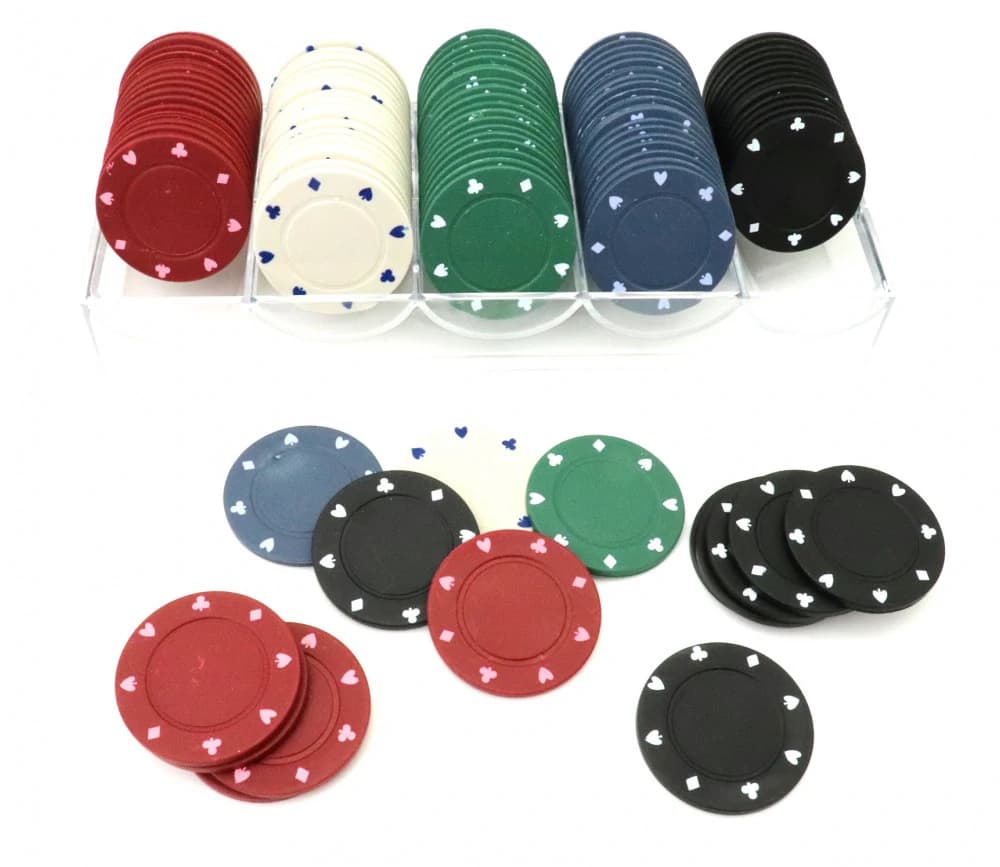
What are poker chip values based on their color?
In poker, each chip color corresponds to a value. This helps manage bets without using cash. There is no fixed rule for chip values based on their color, but a common distribution is used for home games with standard chip sets. Here it is:
| Color | Value |
|---|---|
| White | €1 |
| Red | €5 |
| Green | €25 |
| Blue | €50 |
| Black | €100 |
| Yellow | €1,000 |
For tournaments and casino games, chip values and colors may vary. Casinos often choose their own colors for security reasons or to offer a unique experience to players.
Now that you know how much each chip is worth, let's see how this changes in tournaments and cash games. Then, discover how to properly distribute them for your home games.
Tournament Chip Values
In tournaments, chips do not represent real money. They are only used to track bets and progress through the tournament. Chip values vary from tournament to tournament, but here are the typical values:
| Color | Value |
|---|---|
| Green | 25 |
| Black | 100 |
| Purple or Light Blue | 500 |
| Yellow or Gold | 1,000 |
| Orange or Gray | 5,000 |
| Dark Green or Brown | 25,000 |
| Pink or Lavender | 100,000 |
| Red | 500,000 |
| Light Yellow | 1,000,000 |
You'll notice a difference from the table at the beginning of the article. That's because in tournaments, white, red, and blue chips are typically not used, even though they're often included in most chip sets sold commercially.
Color-ups
The "color-up" is an important step in tournaments to keep the game flowing smoothly. As blinds increase, small chips are replaced with higher-value chips. This prevents having too many small chips and simplifies the game.
The color-up is usually done after several blind levels to keep the game fast and simple.

Chip Stacking Norms
In poker tournaments, chips are often stacked in groups of 20. This helps players and dealers count quickly. These stacks are organized by color, making it easy to see the total value of each stack. This method is useful for keeping bets clear and ensuring smooth gameplay.
Stacking chips in groups of 20 also helps players track the size of their own stack without wasting time calculating it.

Our latest videos
Cash Game Chip Values
In cash games, each chip has a real money value. Here are the common values:
| Color | Value |
|---|---|
| White | €1 |
| Red | €5 |
| Blue, Brown, or Orange | €10 |
| Green | €25 |
| Black | €100 |
| Purple | €500 |
| Yellow, Orange, or Gray | €1,000 |
| Orange, Gray, or Red/White/Blue | €5,000 |
| Dark Green, Dark Blue, or Brown | €25,000 |
| Light Blue or Gray | €100,000 |
These values allow players to easily adapt to different buy-in amounts and blind levels.
Setting Up Chips for a Home Poker Tournament
For a friendly tournament, it's important to choose chip values, the blind structure, and know how to distribute them.

How Many Chips to Give Each Player?
There's no fixed rule for how many chips to distribute. A simple method is to divide the stacks of each color by the number of players at the table. Don't distribute all the green, blue, and black chips because of their high value.
For example, if you have 5 players and a 300-chip poker set distributed as follows:
- 100 white chips
- 50 red chips
- 50 green chips
- 50 blue chips
- 50 black chips
You can distribute:
- 20 white chips per player
- 10 red chips per player
- 8 green chips per player
- 5 blue chips per player
- 2 black chips per player
In any case, as we'll see below, the most important thing is to structure the blinds correctly to determine the length of the game.
Determining the Length of the Poker Game
The blind structure greatly influences the length of the game. In most poker formats, the blind amount increases as the game progresses to force the elimination of players at the table.
To structure the blinds, you need to:
- Set the starting blinds (usually 1 for the Small Blind and 2 for the Big Blind).
- Choose the next blind levels (for example 2-4, then 5-10, then 10-20, etc.).
- Assign a duration to each blind level.
Does this seem complicated? Don't panic! There are sites like Poker Soup that make it very easy to set up.
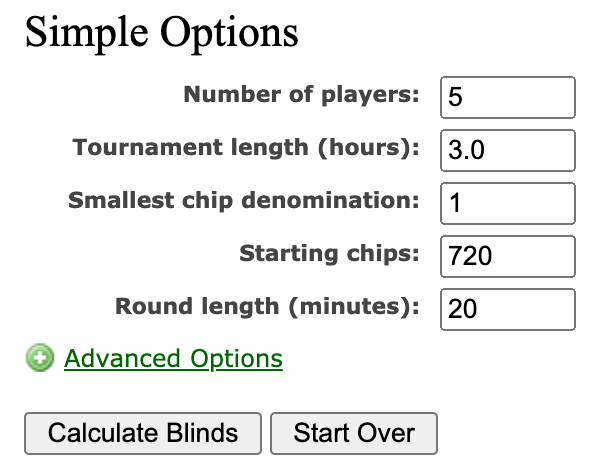
For example, using Poker Soup, you can set the following parameters:
- Number of players: simply enter the number of participants in your poker game.
- Tournament length: the blind levels chosen by the site will ensure your game lasts approximately this long.
- Smallest chip denomination: the value of the smallest chip used (in our example above: 1).
- Starting chips: calculate the total sum of chips for each player. In our example: 20 × 1 + 10 × 5 + 8 × 25 + 5 × 50 + 2 × 100 = 720.
- Round length (minutes): it's recommended to choose a duration of about 20 minutes to avoid changing blind levels too often.
Here's the blind structure that Poker Soup suggests:
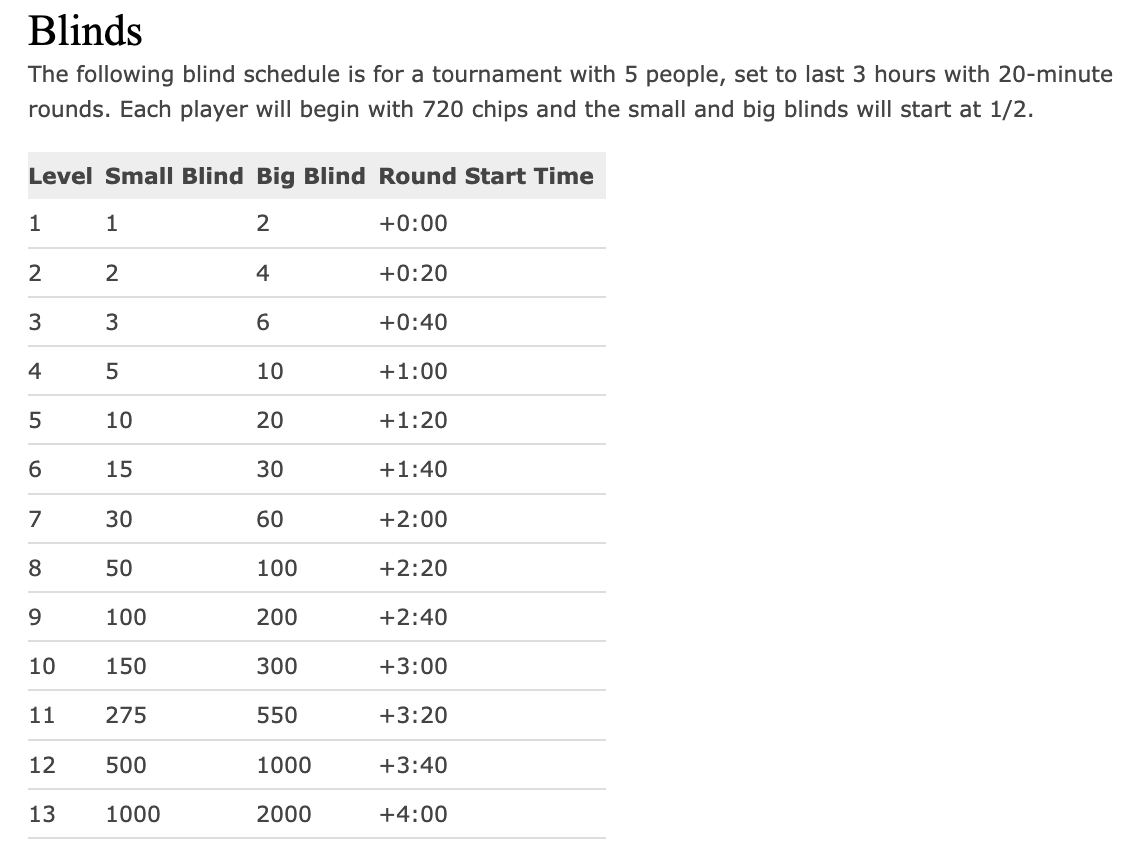
The site suggests starting with 1-2 blinds, then after 20 minutes moving to 2-4 blinds, and so on, for a game that should last about 3 hours.
Setting Up Chips for a Home Cash Game
For home cash games, you need to think carefully about chip distribution. The principle is different from tournaments.
How Many Chips to Give Each Player?
For a cash game, it's recommended to give enough chips so that each player has between 50 and 100 times the big blind. This allows for long play without having to exchange real money for chips.
🏿 For example, if the blinds are €1 / €2, each player should receive between €100 and €200 in chips, split into different values to facilitate betting.













Different Types of Poker Chips
There are several types of poker chips, each with its own characteristics. The choice often depends on the type of game and the players' preferences.
Plastic Chips vs Clay and Ceramic Chips
Plastic chips are often the cheapest. They're commonly used for home games. They're lightweight, easy to handle, and available in many sets sold to the general public. However, they can feel less pleasant to handle for players used to more serious games.
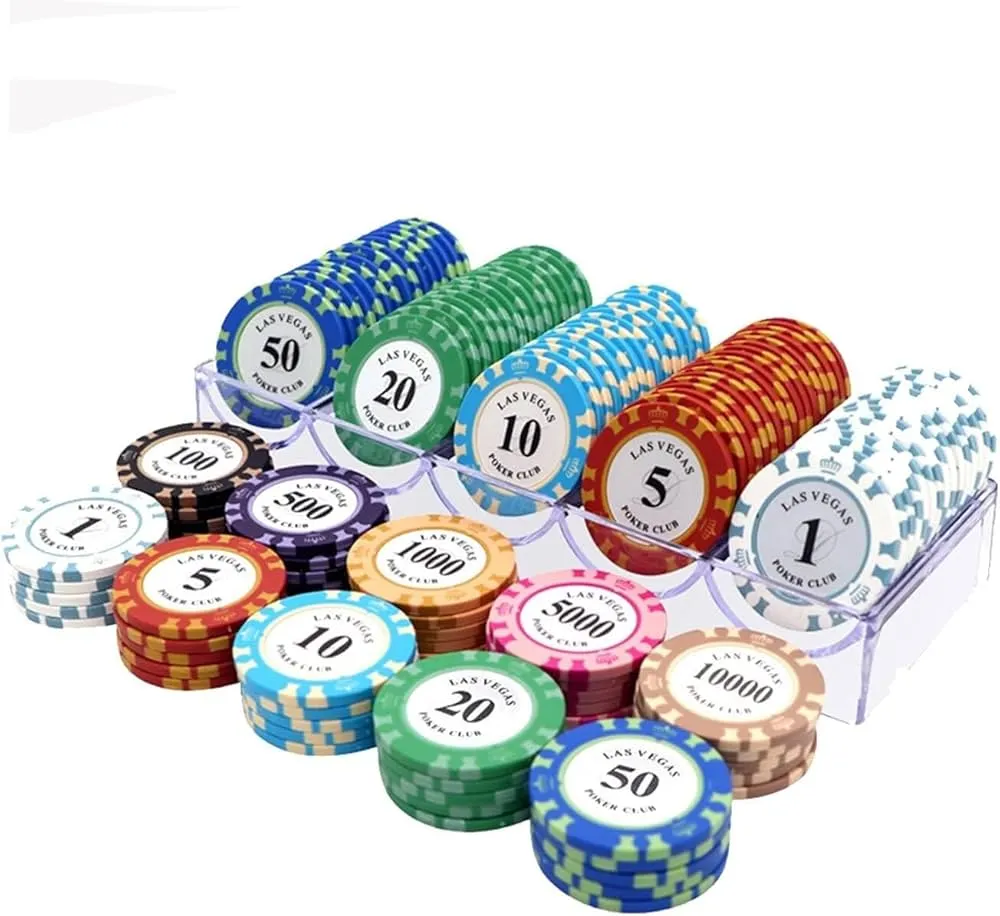
Clay or ceramic chips are of higher quality. They're mainly found in casinos and professional tournaments. They're heavier and more pleasant to handle and stack. Their unique texture also provides a better grip. These chips offer a more authentic gaming experience, but they're more expensive.
RFID Chips (Radio Frequency Identification)
RFID chips are used in casinos for security. They contain an electronic chip that allows casinos to track each token and ensure it's authentic. This reduces the risk of fraud and provides better control over the chips in use. These chips are almost never used outside of casinos, but they represent an important advancement in poker game security.

Chip FAQ
To wrap up, here's a list of quick-reference questions for readers in a hurry:
What color is a $100 chip?
A $100 chip is generally black, but this can vary depending on the casino.
How many chips do you get at the start of a poker tournament?
The number of chips at the start of a tournament depends on the structure. Generally, each player receives a set amount of chips determined by the organizer. This typically ranges between 5,000 and 50,000 units.
Are chip colors universal?
No, chip colors are not the same everywhere. They can change depending on the casino or tournament. However, some colors are commonly used, such as white, red, green, and black.
How do casinos verify their chips?
Casinos use several methods, including UV markings and embedded RFID chips. These systems ensure that only authentic chips are used, thus reducing the risk of fraud.