

In the previous chapter, we looked at how to play GTO from the Small Blind facing a Button open.
We will now study the same situation, but from an Exploitative angle: how to adjust our decisions to maximize our profits against a recreational BTN and BB.
The structure of the spot remains exactly the same:
These constraints do not disappear. But… our opponents do not play perfectly. And that is where exploitative opportunities arise.

Many recreational players have two major leaks:
😴 As you will have noticed many times in the Strategy Guides, the lack of aggression is a recurring trait of recreational players.
These two tendencies give us several advantages:
Since the BB rarely squeezes, we are less likely to face a 3-bet shove from BB.
This allows us to call certain hands that GTO would normally fold or shove.
A recreational BTN bets less often, uses smaller sizings, and gives up more frequently.
This means that our borderline hands realize their equity more easily, making calls more profitable.

Against recreational profiles, a non-aggressive line (calling) with similar EV to a shove is often preferable.
Why take a high-variance preflop spot when the opponent will play poorly postflop?
Once you understand GTO charts, the entire exploitative strategy revolves around a simple idea:
Which hands do we 3-bet shove, and which hands do we simply call?
As we saw in the previous chapter, a simple push-or-fold GTO strategy can already be very effective.
But as soon as we try to exploit recreational tendencies, we must add some calls to our range.
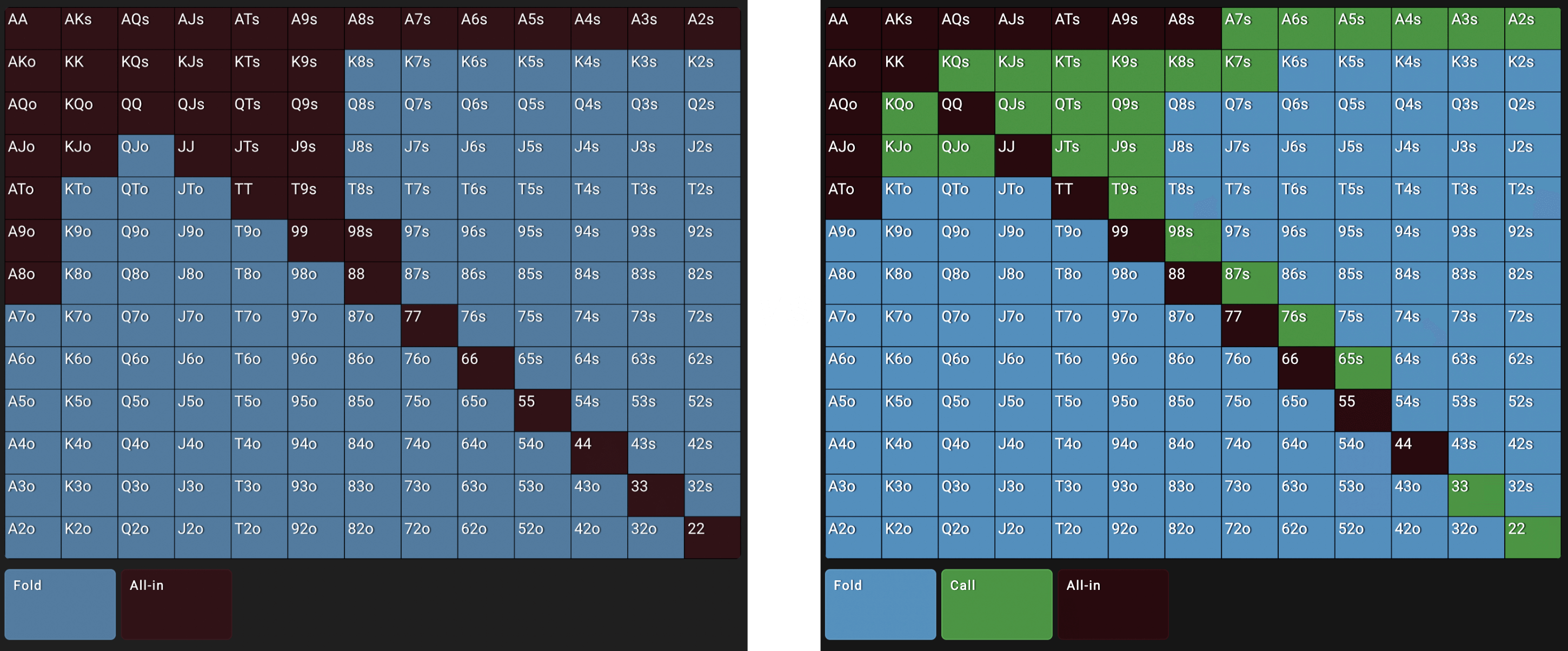
🤷 So of course, we call hands that GTO would fold and we call hands that GTO would shove.
Even though calling becomes more profitable under the right conditions, we must avoid going too far:
Everyone can adapt the strategy depending on their skill level and the opponents at the table.
❌ Unlike GTO, an exploitative strategy is not a fixed method to memorize, but a flexible approach that constantly adapts to your opponents’ tendencies.
Always try to keep this in mind.