
Now that you master the GTO calling chart in the Big Blind in heads-up, we are going to see how to adjust this chart against recreational players.
When dealing with BB calling charts versus a Small blind shove, especially against recreational players, it is crucial to understand one thing:
👉 this situation is often tricky, because opponents’ shove ranges are not always coherent or balanced.
Calling decisions in the BB versus a SB shove therefore require a lot of discipline and, above all, adaptation.
The exploitative calling charts proposed on Poker Sciences are, in general, intentionally tight. This choice is based on two fundamental realities in Spin & Go.
First of all, most recreational players do not shove often enough, especially below 12 BB (see the comparison table in the Strategic Guide).
You will rarely see them shove hands such as:
And when they do shove, they usually do so with a stronger range than what GTO would suggest (once again, I invite you to check the end of the Strategic Guide, where this is explained in detail).
In short: their shove range is relatively strong, which is why we will call tight.
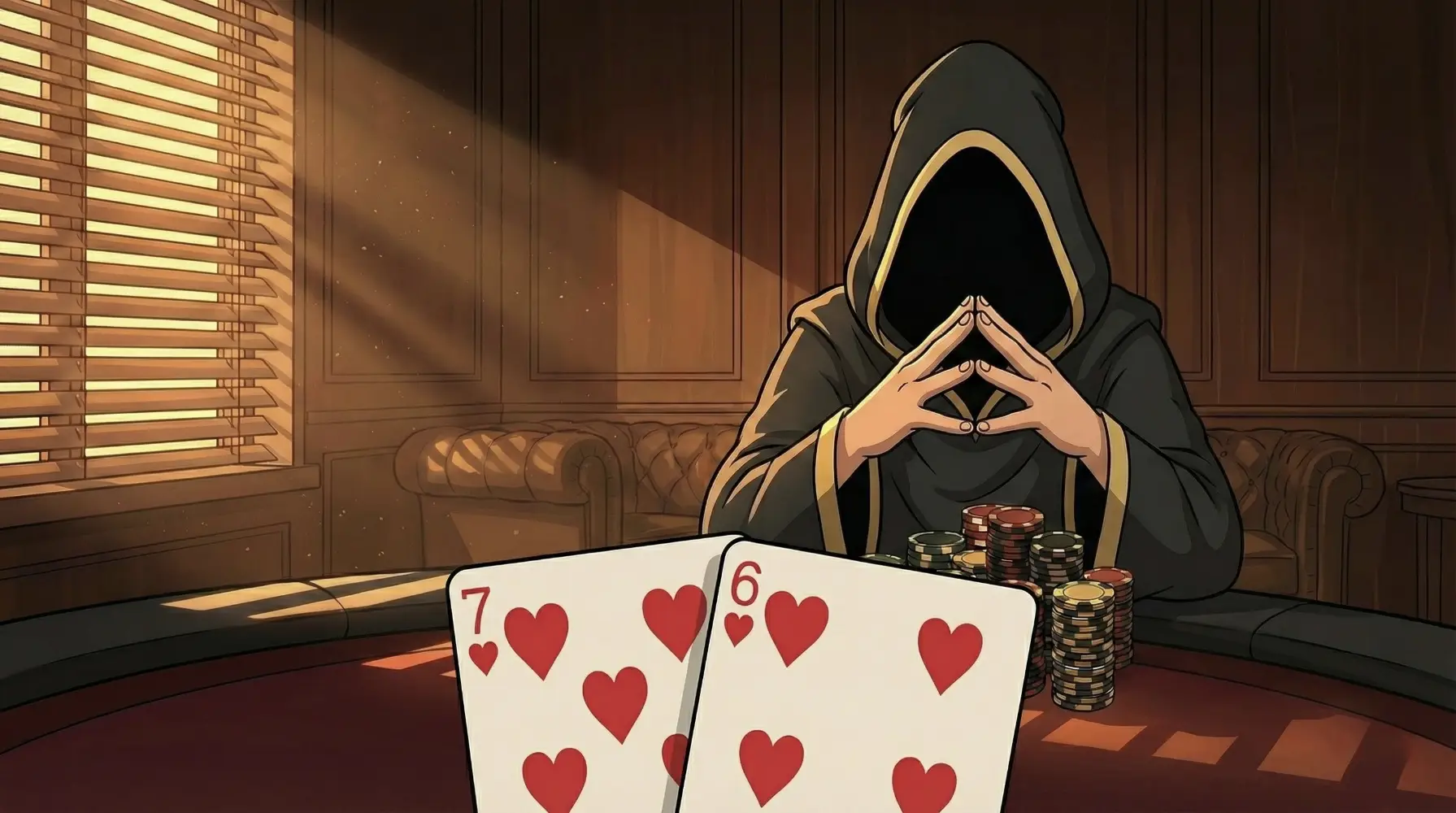
Secondly, and just as importantly, we have a structural edge over these opponents.
The deeper we are, the less interesting it is to play our Spin on a coin flip or on a slightly +EV spot, even if raw calculations indicate a profitable call.To fully exploit our edge, we prefer to avoid unnecessary variance.
This is where many players make mistakes.
In most cases, recreational players shove too little (especially below 12 BB, as mentioned), and our exploitative calling charts, which are tighter than GTO, work very well.
However, there are also more aggressive profiles, who shove more than average, sometimes close to GTO frequencies. In those cases, our exploitative charts become too tight.
☝️ Against this type of opponent, failing to adapt is a costly mistake. It becomes essential to widen our calling chart, especially at medium stack depths.
Enough theory, here is the adaptation logic. I have prepared a diagram to make everything clearer visually:
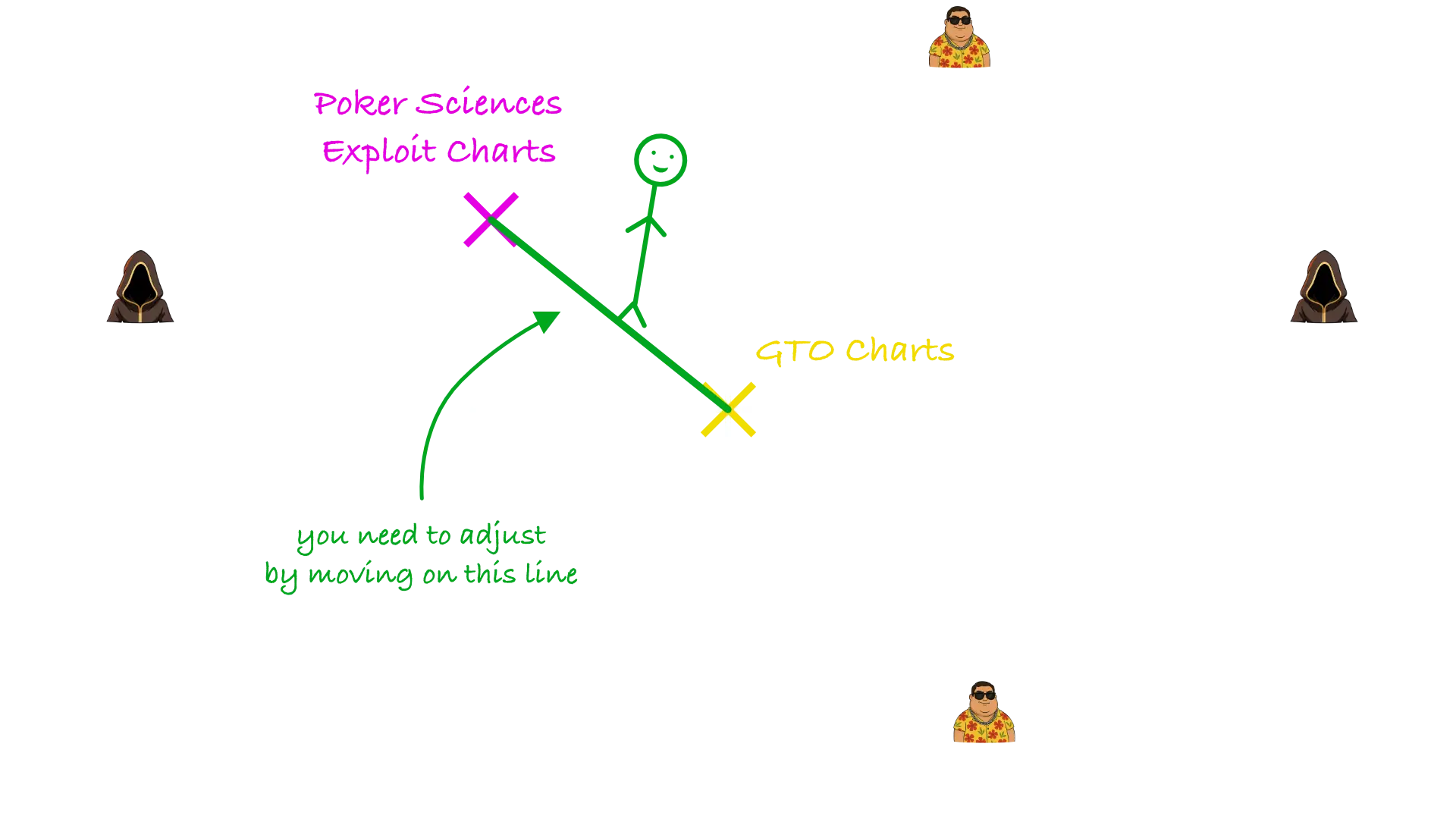
Depending on Villain’s profile (vertical axis), you will move along the green line.
You will move closer to GTO (yellow choice 🟡) if Villain shoves as much as he theoretically should (which is rare), or instead move toward the exploitative ranges (purple cross 🟣) if he shoves too little/strong (which is usually the case).
So, if you notice that your opponent shoves very rarely, which is true for many recreational players, you can safely apply the exploitative calling charts proposed on Poker Sciences.
These are the charts you will train with on the Trainer.
↔️ On the other hand, if you face a player who shoves frequently, or if you play in a room or format where recreational players are more aggressive, you must widen your calling chart, that is, on the diagram above, move down along the green line toward GTO.
Above 12 BB
Because of Facts #1 and #2 mentioned earlier, our exploitative charts are relatively tight compared to GTO.
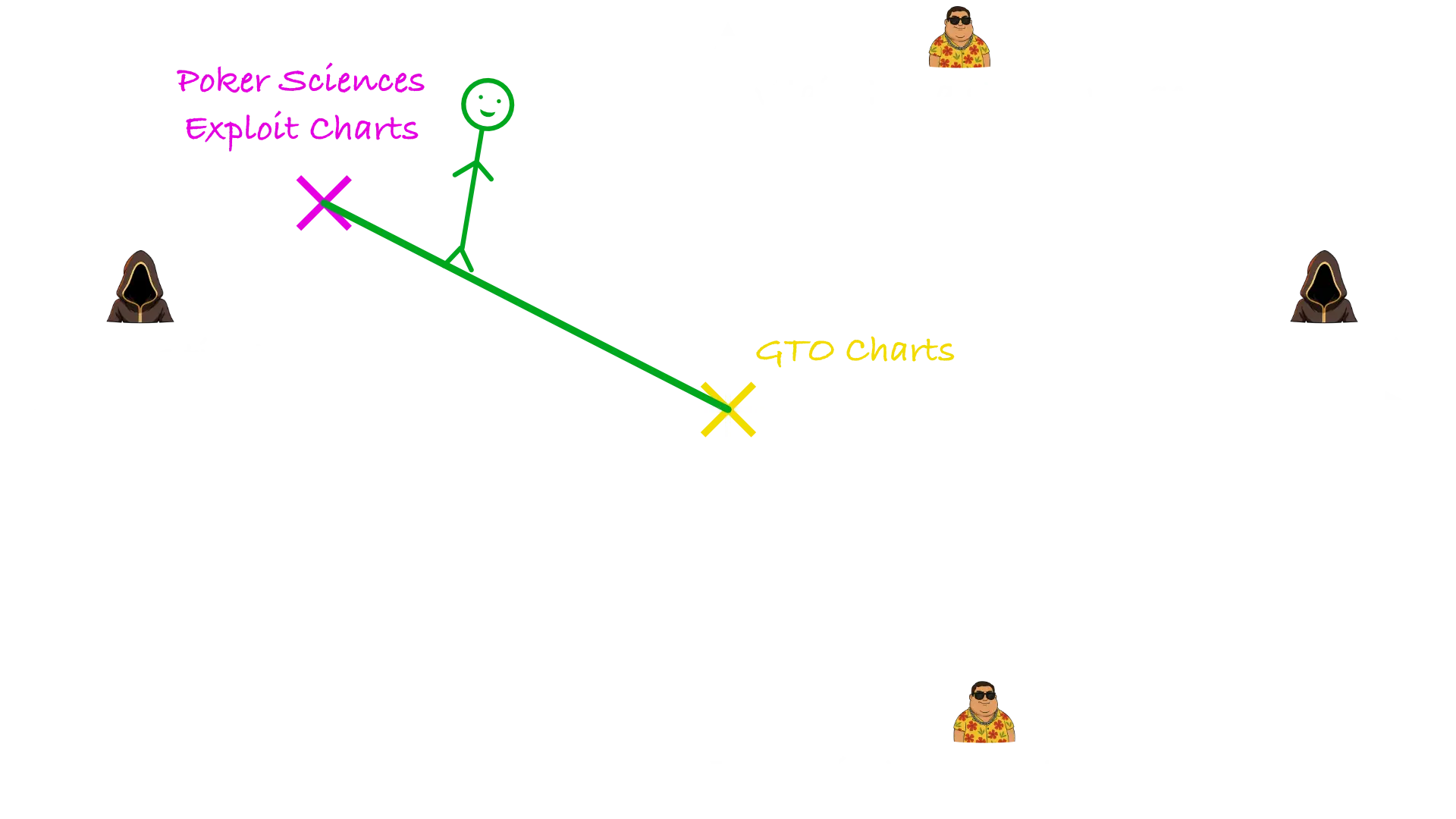
At these depths, you still have many playable hands, and against an opponent you dominate, future EV often compensates for the marginal EV you give up in the short term.
You can therefore afford to play relatively tight, provided, of course, that your opponent does not have an excessively wide shove range (in which case, you should move toward GTO).
⚠️ And to be clear: this does not mean you should systematically refuse +EV spots. Everything is a matter of balance.
Overestimating your edge and folding too much can lead to a much more dangerous situation: becoming very short (3–4 BB) and easily exploitable, even by a recreational player.
From this depth onward, it becomes increasingly important to widen your calling chart and move closer to GTO, especially if Villain starts shoving more frequently.
We have less postflop edge and therefore less room to exploit our opponent.
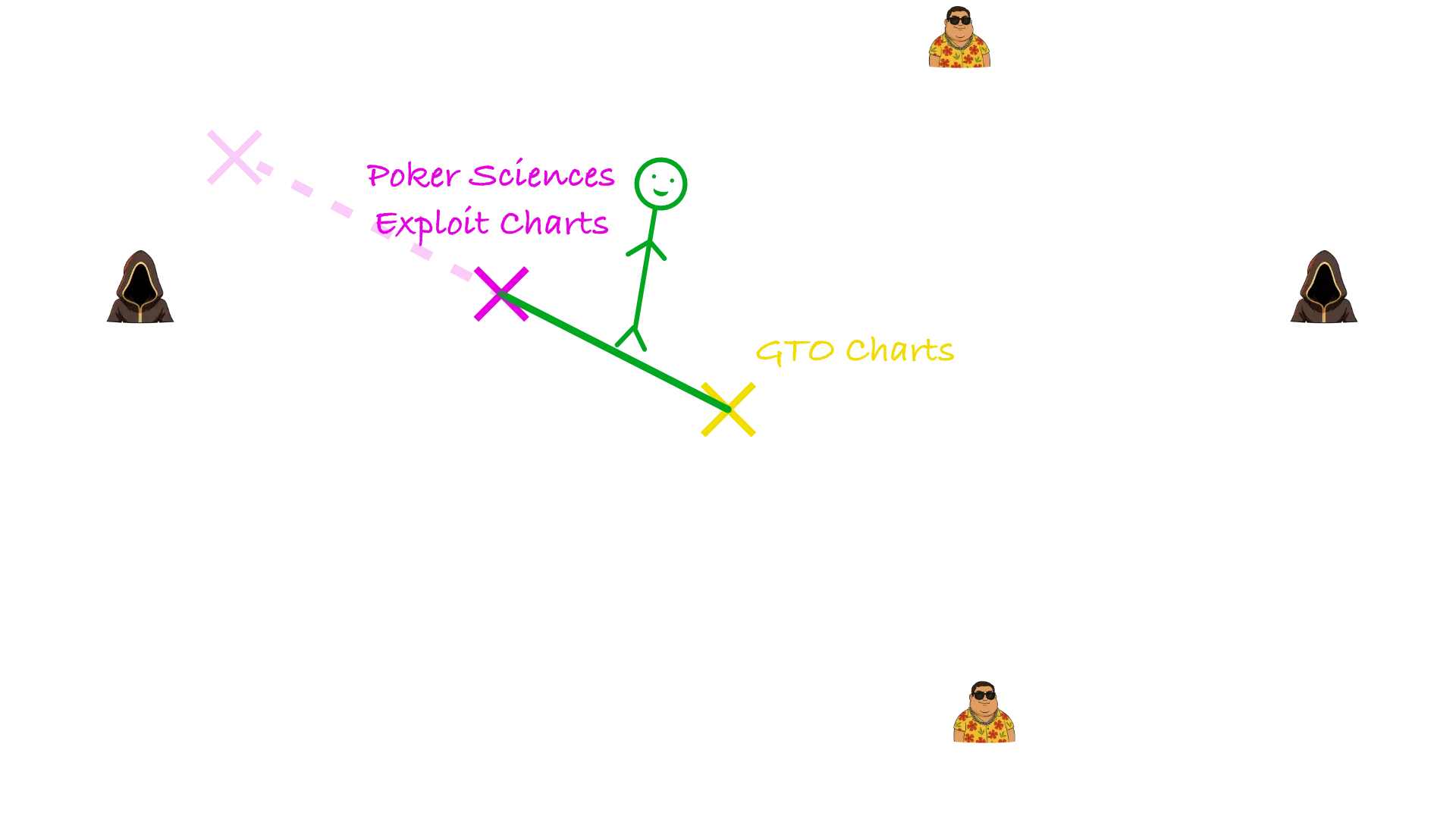
Below 5–6 BB, this effect becomes even stronger, and let’s be clear: there is no longer any room for exploitation.
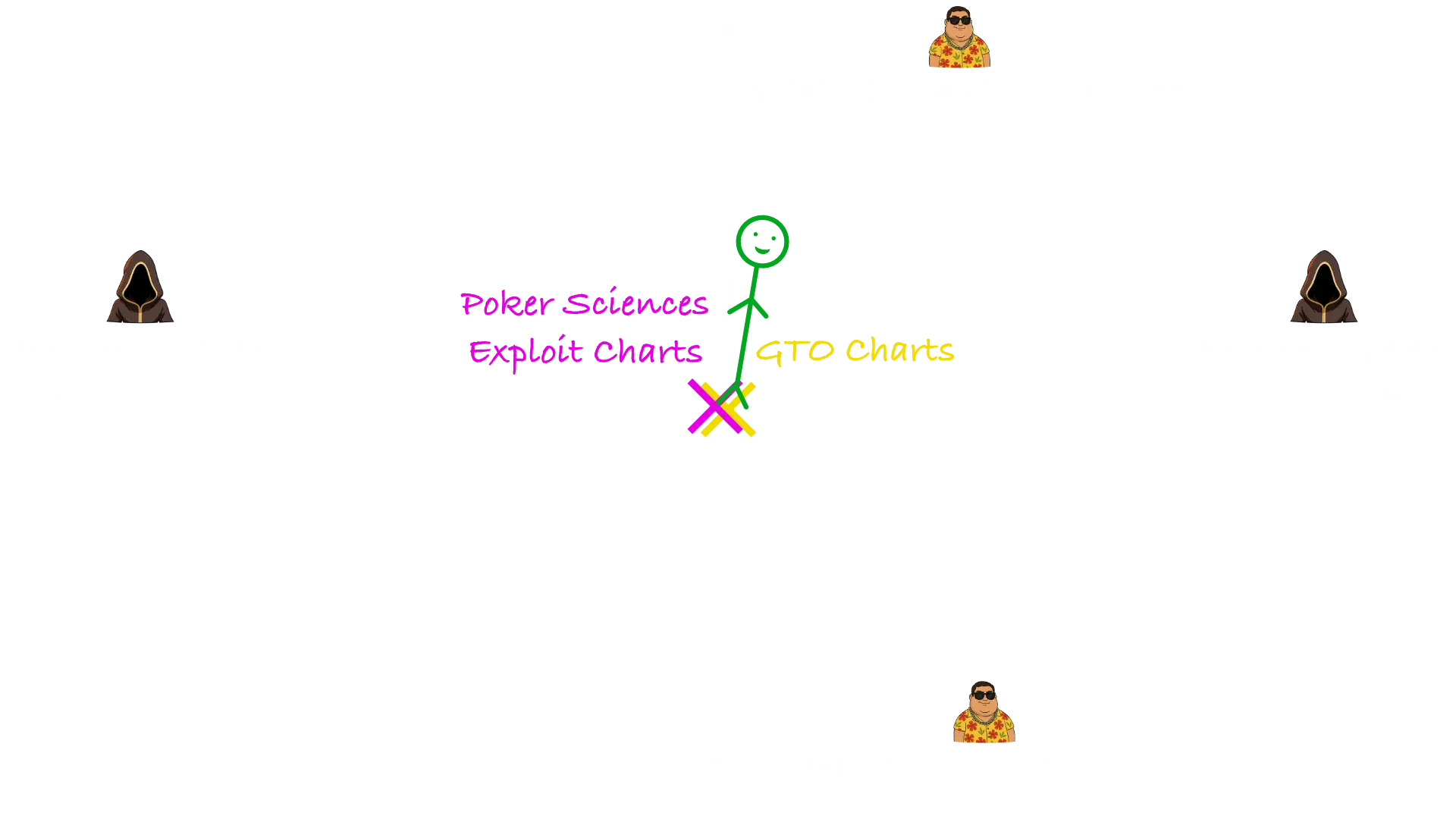
At these depths, trying too hard to exploit opponent tendencies becomes risky.
To avoid being exploited while trying to exploit, it is best to stick closely to GTO calling charts. Margins are small, fold equity is limited, and every mistake is immediately punished.
🔁 This is why you will notice that the questions asked between 0 and 5–6 BB are exactly the same as in the previous chapter: we simply play GTO.
Ultimately, as you can see, applying BB calling charts correctly versus an SB all-in is difficult, because many parameters must be taken into account.
Opponent shove frequency, stack depth, overall edge against Villain, and future EV — all of these factors matter.
You must neither:
The goal is always the same: maximize your overall EV across the entire Spin, not just the immediate decision.It is precisely this ability to make measured adjustments that makes the difference between a decent player… and a very strong Spin & Go player.
But don’t worry, over time, your intuition will improve, and I’m confident you’ll consistently make the best decisions.