1️⃣ The main mistake is calling too wide against recreational players.
2️⃣ Recreational players shove a stronger range than GTO → we need to call tighter.
3️⃣ Even if a call is slightly EV+, it may still be suboptimal: avoiding unnecessary confrontations helps you stay in the game longer.
4️⃣ However, at 9–10 bb and below, it becomes necessary to widen your calling range.
When a player in the SB open-shoves, it’s tempting to call with a hand that’s “not that bad.”
But that’s often a mistake.
Many players believe they should call as soon as a spot is slightly EV+, but in practice, this approach increases variance without meaningful gains.
Recreational players shove less often than GTO, especially under 12 bb (see detailed frequency chart below).
Their range is thus stronger and more merged, typically centered around relatively solid hands.
Many technically EV+ calls are too marginal to compensate for the elimination risk against an opponent who is easy to beat postflop.
In a situation where you have an edge, your goal is to wait for better spots and take advantage of your opponent’s mistakes.
Calling with a borderline hand — even slightly EV+ — could cost you the entire game for a minimal gain.
Example: calling 87s vs a 12 bb shove might be theoretically EV+, but if you lose, you’re out.
➡ It’s often more profitable to fold and wait for clearer, higher-EV spots.
Starting around 9–10 bb or less, every hand matters. If you fold too much at this stack depth, you won’t be able to recover the missed EV in later hands.
➡ Adopt a progressive logic:

Here’s a chart showing open shove frequency by stack depth.
It helps us compare the actual frequency of recreational players with GTO’s optimal frequencies:
We can see that under 12 bb, recreational players often don’t shove enough.
Let’s now zoom in on 12 bb and compare rec player shoves to GTO:
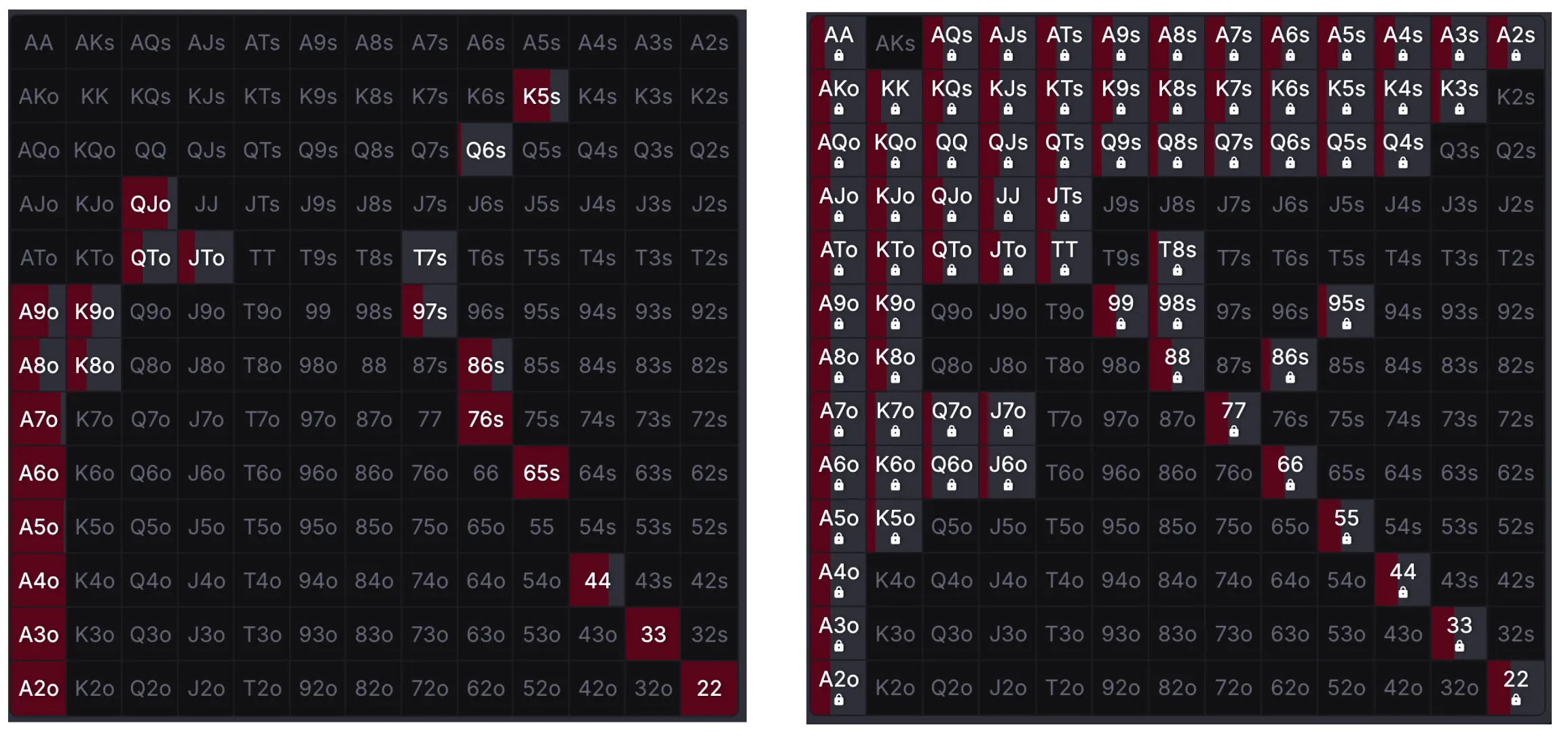
We can see that not only do recs shove fewer hands than GTO (12% vs 16% at 10–12 bb), but they also tend to shove a stronger, merged range.
This imbalance clearly justifies a tighter-than-GTO defense against recreational players when you’re in the BB vs an SB shove.